For countless medical aspirants across the country, cracking the National Eligibility cum Entrance Test (NEET) is the ultimate dream. It requires years of sleepless nights, intense coaching, and unimaginable sacrifices. But what happens when the very system designed to test merit is compromised by underground syndicates?
The NEET-UG paper leak controversy has evolved into one of the most explosive educational crises in recent history. As millions of students face uncertain futures and the nation watches in disbelief, the crisis has exposed deep-rooted vulnerabilities in India’s centralized examination infrastructure. Here is a comprehensive breakdown of the context, the harsh reality of the investigations today, and the sweeping reforms demanded by the Supreme Court.
The Context: How The System Broke Down
To understand the magnitude of this crisis, you must look at the sheer scale of the operation. NEET is the gateway for medical admissions across India, handling well over two million candidates in a single session. For years, the National Testing Agency (NTA) relied on traditional pen-and-paper testing, which requires a massive physical logistical chain: printing presses, secured transportation, bank vaults, and thousands of examination centers.
The paper leak occurred when this physical chain was breached. Corrupt officials, underground solver gangs, and sophisticated distribution networks collaborated to circulate the question papers on digital platforms just hours before the exam. The immediate fallout was catastrophic. The integrity of the exam was shattered, leading to mass cancellations, widespread student trauma, and a complete loss of faith in the testing authorities.
The Reality Today: Investigations, Protests, and Political Uproar
Today, the reality of the NEET paper leak is a chaotic mix of intense legal battles, street protests, and surprising investigative twists.
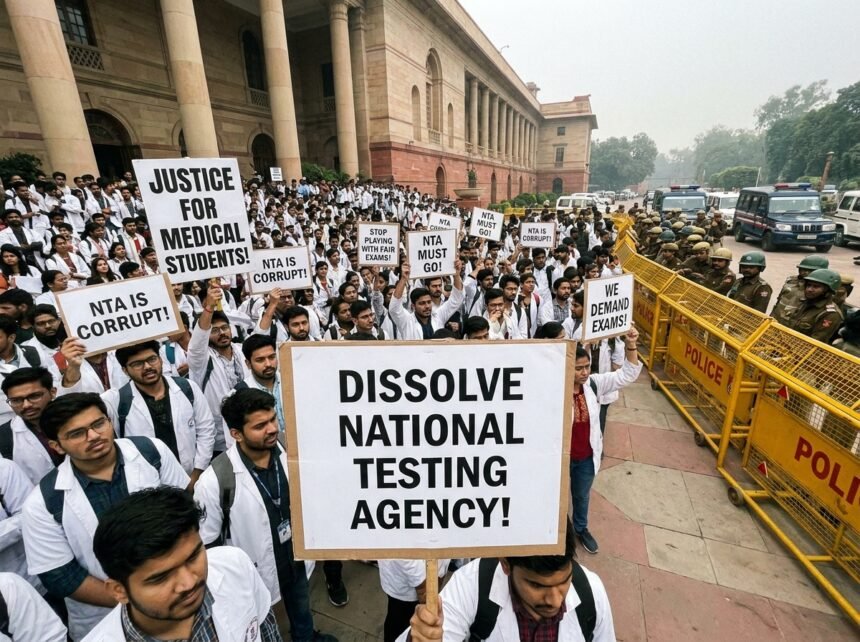
Students and political groups have taken to the streets, resulting in fierce clashes with law enforcement as they demand accountability and the complete overhaul of the NTA. However, the Central Bureau of Investigation (CBI) probe has produced highly controversial developments. Recently, the CBI revealed that they found no concrete evidence linking the prime suspect who was widely believed to be the mastermind to the actual theft and distribution of the specific NEET-UG paper.
While the agency successfully filed multiple chargesheets against dozens of other beneficiaries and conspirators, the omission of the primary suspect triggered massive political uproar. Critics and opposition leaders are actively accusing the government of shielding high-profile criminals, further fueling the public’s anger and distrust in the ongoing investigation.
The Proposed Solutions: The Supreme Court Steps In
Realizing that the examination system is on the verge of collapse, the Supreme Court of India has taken direct charge of monitoring the overhaul. The highest court in the land has made it unequivocally clear that temporary fixes are no longer acceptable.
Following the initial leaks, the government panicked and resorted to extreme, ad-hoc measures—including deploying the Indian Air Force to securely transport question papers. The Supreme Court firmly rejected this approach as a long-term solution, demanding complete, permanent institutionalization.
Relying on the recommendations of the high-powered Radhakrishnan Committee, the court has directed the Centre and the NTA to file comprehensive affidavits detailing their progress on several fronts:
- Expert-Led Governing Boards: Establishing independent oversight committees with strict domain-specific requirements.
- Advanced Candidate Verification: Implementing biometric and digital technologies, such as DigiYatra, to prevent impersonation at exam centers.
- Total Transparency: Creating a flawless system that monitors the pre-examination, during-examination, and post-examination phases with absolute accountability.
Advanced Topics: The Risky Shift to Computer-Based Testing
The most significant reform currently on the table is the complete transition from physical question papers to Computer-Based Testing (CBT), similar to the IIT-JEE model.
While CBT eliminates the physical vulnerabilities of printing and transport, it introduces a terrifying new set of risks. The Supreme Court has actively questioned the government on its cybersecurity roadmap. If physical leaks are replaced by digital hacks or server breaches, the entire centralized database of millions of students could be compromised in seconds. The future of India’s medical entrance exams now heavily depends on creating an impenetrable data protection framework, ensuring that the transition to digital does not simply modernize the corruption.