The One-Minute Answer
If the Moon orbited Earth in exactly the same flat plane in which Earth orbits the Sun, weâd get a lunar eclipse at every full moon. But the Moonâs orbit is tilted by about 5° relative to Earthâs orbital plane (the âeclipticâ). Most full moons therefore pass slightly above or below Earthâs shadow. Only when a full moon happens near one of two intersection points called nodes does the Moon slip into Earthâs shadow and we see a lunar eclipse. These ânode alignmentsâ occur during short windows known as eclipse seasons that come roughly twice a year.
The Big Picture: How Lunar Eclipses Actually Work
SunâEarthâMoon's Lineup 101
A lunar eclipse happens when Earth moves between the Sun and the Moon and casts its shadow across the Moon. That can only happen at full moon when the Moon is opposite the Sun in the sky so Sun, Earth, and Moon are basically in a straight line (astronomers call this alignment a âsyzygyâ).
Two Different Orbital Planes
Earth orbits the Sun in a plane we call the ecliptic. The Moon orbits Earth in its own plane. If those two planes were the same, lining up would be easy: every full moon would dive through Earthâs shadow.
The Moonâs 5° Tilt, Explained Simply
Picture the Moonâs orbit as a slightly tilted hula-hoop around Earth. That hoop is tipped by ~5° compared to the ecliptic. Because of that tilt, the full moon usually rides a little high or a little low missing the âshadow laneâ behind Earth.
The Exact Conditions Required for a Lunar Eclipse
You Need a Full Moon
No full moon, no lunar eclipse. At any other phase, the SunâEarthâMoon geometry isnât right for Earthâs shadow to fall on the Moon.
And That Full Moon Must Be at (or Near) a Node
A node is where the Moonâs tilted orbit crosses the ecliptic plane. If the full moon happens close to a node, the Moon can intersect Earthâs shadow cone. If itâs too far from a node, the Moon sails above or below the shadow and nothing dramatic happens.
Umbra vs. Penumbra (Why Some Eclipses Are Subtle)
Earthâs shadow has two parts:
- Umbra: the dark central cone where the Sun is completely blocked.
- Penumbral: the lighter outer region where the Sun is only partly blocked.
If the Moon only skims the penumbra, the eclipse can be so faint you might barely notice a shading. A deeper pass that clips the umbra yields a
partial eclipse. A full dive through the umbra yields a
total lunar eclipse.
Meet the Nodes: Ascending, Descending, and the âLine of Nodesâ
What a Node Really Is (Without the Jargon)
Think of a globe showing Earthâs orbit as a flat ring. The Moonâs tilted ring crosses that ring at two points on opposite sides those are the
ascending and
descending nodes. The straight line connecting them is the
line of nodes. Lunar and solar eclipses demand that the Sun line up close to that line.
Nodal Precession: The Slow Drift (~18.6 Years)
The line of nodes isnât nailed in place. it slowly drifts backward around Earth, completing a full loop in about 18.6 years. This subtle wobble changes when eclipse seasons happen and influences long-term eclipse patterns.
Eclipse Seasons: Why Eclipses Come in Clusters
Twice a Year Windows (~34-37 Days)
Because the nodes align with the Sun about twice a year, we get two
eclipse seasons annually. Each season lasts roughly five weeks. During these windows, the full moon (and the new moon) occur close enough to a node to make eclipses possible. Thatâs why youâll often see a solar eclipse and a lunar eclipse a couple of weeks apart: they happen within the same season.
Why Some Seasons Have Multiple Eclipses
Depending on timing, a season can include:
- A solar eclipse near new moon,
- A lunar eclipse at the following full moon,
- And occasionally another solar eclipse at the next new moon,
or some variation thereof. The exact count depends on how the full/new moons fall within that roughly month-long window.
Types of Lunar Eclipses
Penumbral The Soft Shadow
Here the Moon walks through Earthâs penumbra. To the casual observer, the Moon just looks a bit dimmer or shaded on one side. Astro photographers notice it more than casual sky watchers.
Partial A Bite Out of the Moon
Part of the Moon moves into the umbra. Youâll see a sharp, curved âbiteâ taken out of the lunar disk, the edge of Earthâs umbra. This is eye-catching and easy to spot.
Total The Coppery âBlood Moonâ
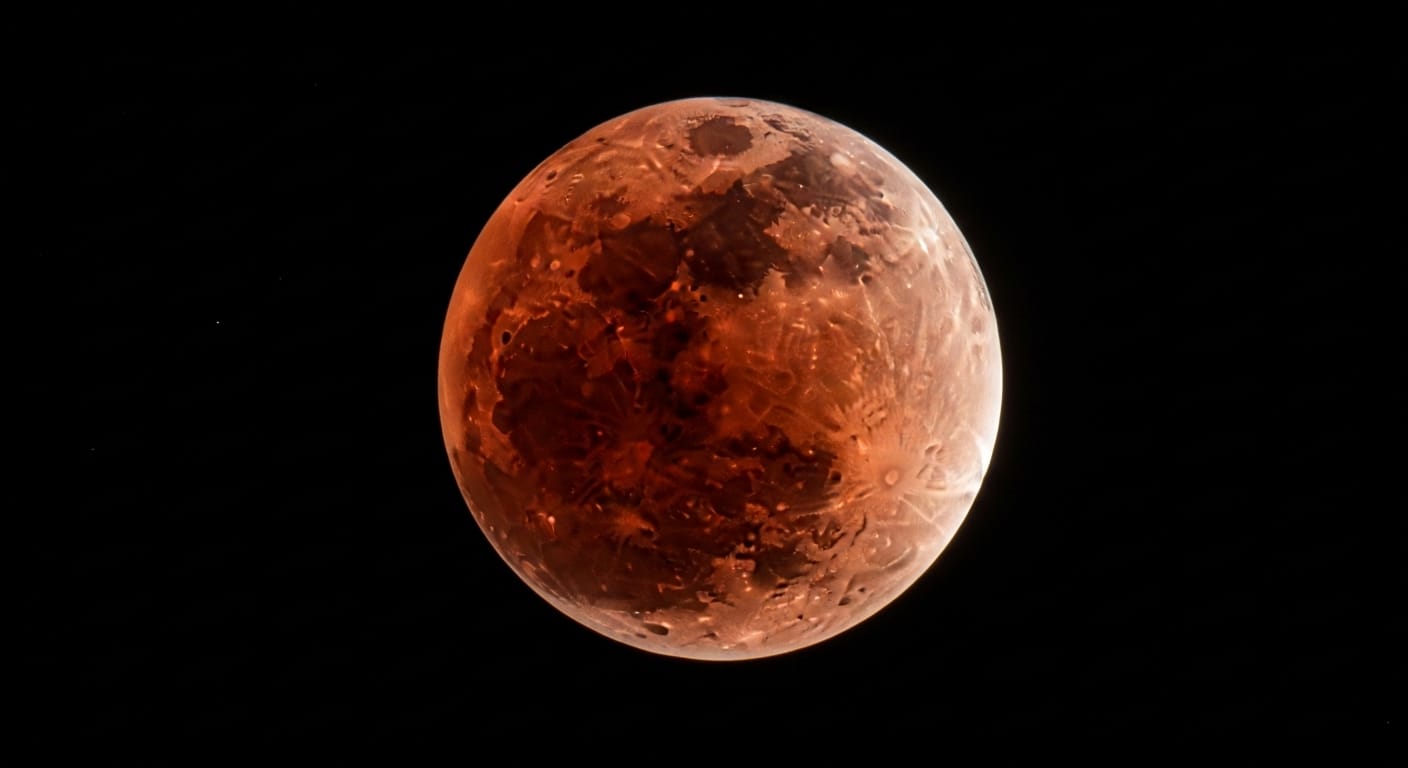
When the entire Moon slips inside the umbra, sunlight canât hit it directly. But Earthâs atmosphere bends and filters sunlight into the shadow, letting in predominantly red and orange hues. Thatâs why totality often looks coppery or brick-red.
So⊠Why Not Every Full Moon? [The Real Answers ;) ]
Most Full Moons Miss Earthâs Shadow
Because of the 5° tilt, the Moonâs path around the time of full moon usually lies
above or
below the ecliptic plane, so it doesnât cross the dark central cone of Earthâs shadow. Only when full moon timing lines up with a nearby node is an eclipse possible.
Visualizing the Miss: âShadow Lanesâ Analogy
Imagine a highway (the ecliptic) and a slightly elevated overpass (the Moonâs orbit). Cars (full moons) on the overpass zip past the highway without touching it. Only at the ramps (the nodes) can a car switch from the overpass to the highway. those ramps are the short windows when the Moon can actually intersect Earthâs shadow.
Distance, Size, and Geometry
Perigee vs. Apogee (Supermoons & Duration)
The Moonâs orbit is slightly elliptical. When itâs closer to Earth (
perigee), it looks a bit larger and moves faster across the sky. When itâs farther (
apogee), it looks a bit smaller and moves slower. This affects eclipse
duration:
- A larger, slower Moon (near apogee) can spend longer in the umbra, potentially stretching totality.
- A smaller, faster Moon (near perigee) can shorten how long it stays in the deepest shadow.
Earthâs Umbral Cone and Why It Narrows
Because the Sun is much larger than Earth and very far away, Earth casts a
cone-shaped umbra that narrows with distance. By the time that cone reaches the Moon, the shadow is still big enough to cover the lunar disk, but not by an infinite margin. A small change in alignment can mean the difference between âtotalâ and âjust missed.â
The Calendar Behind Eclipses
Synodic vs. Draconic Months (29.53 vs. ~27.21 Days)
- The synodic month (~29.53 days) is the interval from full moon to full moon.
- The draconic month (~27.21 days) is the time it takes the Moon to return to the same node.
Because these two clocks tick at different rates, full moons donât consistently line up with nodes. Most months, the timing is off, and full moon happens when the Moon is too far above/below the ecliptic to meet the shadow.
The âEclipse Limitâ Window Around Nodes
Astronomers talk about an
eclipse limit a range around the node where alignments are close enough for an eclipse to occur. If the full moon happens outside that limit, no eclipse. Inside it, you can get penumbral, partial, or total depending on how deep into the umbra the Moon passes.
The Saros Cycle (~18 Years, 11 Days)
Eclipses repeat in recognizable families called
Saros cycles. After about 18 years and 11 days, the SunâEarthâMoon geometry recurs closely enough that a similar eclipse happens again. Itâs not identical (because Earth has rotated about 8 hours further), but itâs strikingly similar and part of a long-running series that migrates slowly over centuries.
Watching a Lunar Eclipse Like a Pro
No Telescope Needed Safety & Visibility
Unlike solar eclipses, lunar eclipses are perfectly safe to watch with the naked eye. Binoculars or a small telescope make the shading and colors more dramatic, but theyâre not required. Weather permitting,
half the Earth (the night side) can see a lunar eclipse, this makes them more widely visible than narrow-path total solar eclipses.
Why the Moon Turns Red (Rayleigh Scattering)
During totality, Earth blocks direct sunlight. But light skimming through Earthâs atmosphere bends into the umbra. Air molecules and dust preferentially scatter blue light (thatâs
Rayleigh scattering), letting more red/orange light through hence the Moonâs coppery glow. The exact hue can change with atmospheric conditions (dust, aerosols, volcanic ash).
Common Myths, Busted
- âWe should get one every full moon.â Only if there were no tilt. The Moonâs 5° orbital tilt is the reason most full moons miss the shadow.
- âBlood moons predict disasters.â No. The red color has a straightforward physical cause: sunlight filtered through Earthâs atmosphere.
- âEclipses are rare.â Not really. Eclipse seasons come twice a year. Whatâs rare is having perfect weather and a convenient time for your location.
- âYou need special glasses for lunar eclipses.â Thatâs for solar eclipses. Lunar eclipses are safe to view with unaided eyes.
DIY Classroom (or Living-Room) Demonstration
You can model eclipses with a lamp (Sun), a basketball (Earth), and a ping-pong ball (Moon) on a skewer:
- Turn off the lights and switch on the lamp, this is your âSun.â
- Place the basketball about a meter from the lamp, this is âEarth.â
- Move the ping-pong ball around Earth on a tilted path (hold the skewer at an angle).
Most of the time, at âfull moonâ (ball opposite the lamp), the ball will pass above or below the basketballâs shadow on the wall.
- When the ball passes through the darkest part of the shadow, youâve made a lunar eclipse.
- Mark two points where the tilted path crosses the lampâs âequatorialâ line, those are your nodes. Notice how eclipses only happen when âfull moonâ occurs near those points.
Pro tip: Use a second person to hold the âMoonâ and keep the tilt consistent so you can see how hard it is to get things perfectly lined up.
Conclusion: The Beauty of Celestial Timing
We donât see a lunar eclipse every month because the Moonâs orbit is tilted by about 5° relative to Earthâs path around the Sun. That small tilt makes a big difference: most full moons pass just above or below Earthâs shadow. Only when a full moon happens near one of the orbitâs two nodes during an eclipse season, does the Moon slip into the umbra or penumbra and put on a show. The interplay of orbital planes, nodal drift, and lunar distance weaves an elegant celestial rhythm that explains why eclipses arrive in predictable clusters, vary in depth and color, and repeat in long Saros families. Far from being random or mystical, each eclipse is a teachable moment in orbital mechanics and a reminder that even a 5° tilt can shape what we see in the night sky.
FAQs (Quick Answers to Common Questions)
1) Why is the Moonâs 5° tilt such a big deal?
Because Earthâs shadow isnât enormous at the Moonâs distance. A small tilt means that, at most full moons, the Moon simply misses the narrow âshadow lane.â That 5° is the difference between a dramatic eclipse and a routine full moon.
2) How often do lunar eclipses happen?
Eclipse seasons occur about
twice a year, and not every season produces a visible lunar eclipse for your location. Globally, you can expect at least a couple of lunar eclipses (of some type) most years, but local visibility depends on time of night and weather.
3) What determines whether an eclipse is total, partial, or penumbral?
How deeply the Moon travels into Earthâs shadow. A shallow graze through the penumbra gives a subtle eclipse; clipping the umbra yields a partial; passing entirely through the umbra produces a total eclipse.
4) Why does the Moon turn red during a total eclipse?
Earthâs atmosphere bends reddish sunlight into its shadow. Shorter blue wavelengths scatter away, leaving longer red/orange wavelengths to bathe the Moon like seeing all the worldâs sunrises and sunsets projected onto the lunar surface at once.
5) Can I predict eclipses at home?
You canât compute them precisely without tables, but you can understand
when theyâre likely: watch for
eclipse seasons (when the Sun is near a node) and see if a
full moon happens during that window. Astronomy apps, almanacs, and observatory websites list upcoming eclipses with timings for your city.
đ Donât guess the good time, know it: Panchang for today â https://altt.in/panchang/
Please donât forget to leave a review on altt.in's Instagram. Explore more by joining me on instagram