
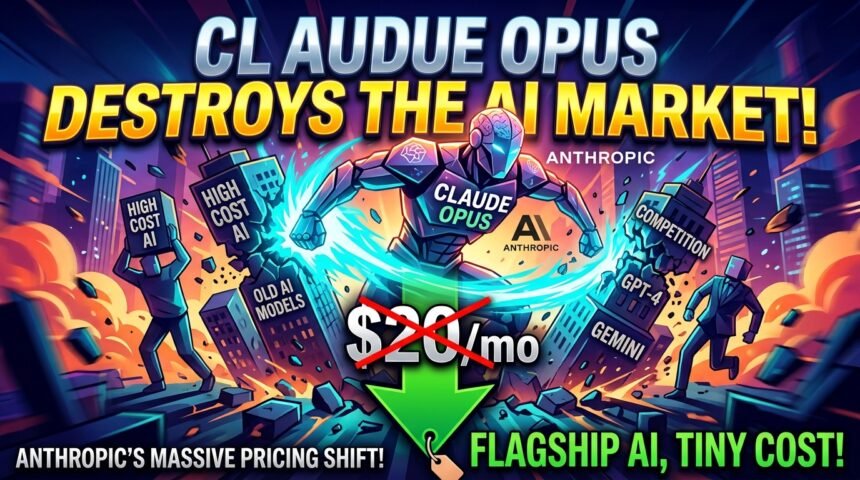
The artificial intelligence industry has spent the last few development cycles obsessed with raw intelligence. Every major tech lab has been racing to build the smartest model, but a monumental shift just occurred. Rather than competing solely on benchmark supremacy, Anthropic just chose token pricing as its ultimate competitive weapon.
With the sudden launch of Claude Opus 5, Anthropic effectively undercut its own flagship product, redefining what developers and enterprises should expect to pay for frontier-adjacent intelligence. If you are utilizing large language models for complex tasks, coding, or agentic workflows, this pricing strategy completely changes the game.
The Problem: The Exploding Cost Of AI “Thinking”
Until very recently, deploying high-tier AI models in a production environment was prohibitively expensive for many software developers and IT departments. The binding constraint for enterprise adoption is no longer how smart the AI is it is what it costs to finish a job.
When you run an “agentic” workflow where the AI loops through files, reads errors, and corrects its own code without human intervention a single task can burn through hundreds of thousands of tokens. Running these continuous loops on top-tier flagship models like OpenAI’s GPT-5.6 Sol or Anthropic’s own Claude Fable 5 meant accumulating astronomical API bills. Tech executives were forced to choose between using incredibly capable but expensive models, or falling back on cheaper, less capable AI that required constant human hand-holding.
The Solution: Flagship Intelligence At Mid-Tier Pricing
Anthropic’s pricing move works like a perfectly executed racecar pit strategy: they took the cheaper option to get ahead in clean air.
Claude Opus 5 carries a rate of $5 per million input tokens and $25 per million output tokens. To put this in perspective, this is exactly half the cost of Anthropic’s flagship Claude Fable 5 model, yet Opus 5 scores a 61 on the Artificial Analysis Intelligence Index actually beating Fable 5 by one point. It even scores two points higher than OpenAI’s GPT-5.6 Sol.
Instead of raising the price for a brand-new model, Anthropic kept the exact same pricing as the older Opus 4.8 while effectively doubling its capabilities.
Real-World Examples: How The Undercut Benefits You
What does this massive price-to-performance ratio look like in practice?
Agentic Coding: Because Opus 5 ties or beats significantly more expensive models on coding benchmarks, developers can allow AI agents to troubleshoot massive codebases on a loop. A problem that takes four automated attempts at $5 per million tokens is far cheaper than paying flagship prices for a model that might get it right on the first try but costs exponentially more.
Large Document Processing: Opus 5 retains a massive context window. You can feed the model a stack of documents roughly the length of eight full novels, and it will only cost about $5 to process the input.
Prompt Caching Savings: The API bills cache reads at a massive discount. If your application repeats the same system prompts or document prefixes, the cached share of your input bill drops by an order of magnitude, making Opus 5 practically free for highly repetitive tasks.
Advanced Topics: The “Fast Mode” Catch
While the base pricing of Opus 5 is a massive win, Anthropic did introduce a fascinating twist regarding latency.
At the standard, ultra-cheap price point, Opus 5 features an adaptive-by-default effort setting. This means the model chooses its own “thinking budget”. The trade-off for the massive price cut is speed; independent monitors note that users might experience a period of silence before the model begins generating its highly capable output.
However, Anthropic has converted speed into a purchasable upgrade. If you need rapid-fire responses, you can activate the new “Fast mode”. Fast mode doubles the price (bringing it to the same $10/$50 rate as Fable 5), but delivers roughly two and a half times the throughput. The choice is now entirely in the customer’s hands: pay half price for raw intelligence and wait a moment, or pay the premium specifically for speed.
By releasing a model that rivals the smartest AI on the market at an aggressively slashed price point, Anthropic has forced the entire industry to rethink its monetization strategies. The race is no longer just about who is the smartest it is about who is the most cost-effective.